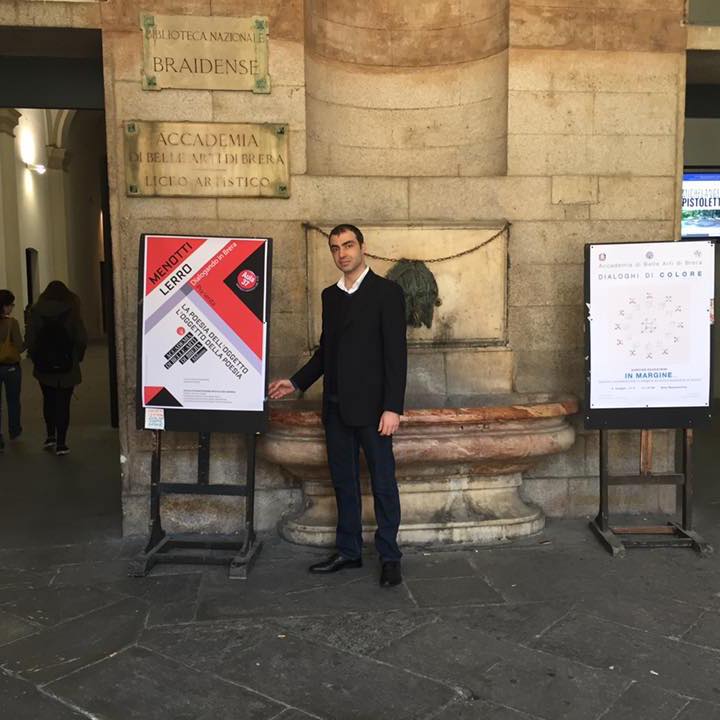
Milan as a Laboratory of the Arts: Menotti Lerro and the Empathic Vision
By Francesco D'Episcopo
Milan occupies a significant place in the cultural trajectory of Menotti Lerro. The documentation collected around his Milanese activities reveals not simply a series of isolated events, but a sustained engagement with one of Italy's most important cultural environments. From academic institutions to galleries, from poetry readings to theatre, from conferences on the arts to exhibitions and cultural meetings, Lerro's presence in Milan appears as a continuous attempt to bring different forms of artistic and intellectual experience into dialogue.
The starting point of this trajectory is particularly significant: the inauguration of the Milan headquarters of the Centro Contemporaneo delle Arti in 2019. Around this institutional moment, the document gathers thirty further Milanese experiences, creating a kind of cultural map of Lerro's activity in the city.
What emerges from this map is the image of Milan as a laboratory of the arts: a place in which poetry, painting, theatre, criticism, teaching, academic research and cultural institutions can encounter one another.
From the Academy to the Gallery
One of the most striking characteristics of Lerro's Milanese activity is its movement across institutional boundaries. His work is documented in connection with the Accademia di Brera, the IULM University, CIELS, the Casa della Cultura, the Casa della Poesia, libraries, schools and galleries.
This variety is important because it reflects a conception of culture that does not isolate artistic disciplines from one another. The academic space becomes a place for poetry; the gallery becomes a place for literary and theatrical reflection; the library becomes a space of encounter; the school becomes a place in which artistic ideas are transmitted to new generations.
Among the documented activities are a workshop at the Accademia di Brera, academic lessons, a conference at the Brera Library and Lerro's participation as a guest at the Academy.
His connection with Milan is therefore not limited to the presentation of literary works. It also involves teaching, discussion, artistic collaboration and the circulation of ideas.
Poetry as Encounter
Poetry occupies a central position within this network. The Milanese documentation includes presentations of Narrating Oneself in Verse at the Casa della Cultura and Raccontarsi in versi at the Casa della Poesia.
There are also encounters with major figures of Italian poetry. One documented event is a poetry reading with Patrizia Valduga, while another concerns meetings with Franco Loi. Lerro also participated in the Letteralmente festival with Nicola Crocetti and many events with Maurizio Cucchi, Milo De Angelis, Giancarlo Pontiggia and all main poets of the period.
These encounters are particularly relevant when considered in relation to Lerro's broader conception of poetry. Poetry is not presented as an isolated act of individual expression. It becomes a form of encounter between voices, generations, traditions and artistic perspectives.
The Milanese experience consequently reinforces an essential principle of Lerro's cultural vision: art gains meaning through relationship.
Brera and the Idea of the Total Artist
The relationship with Brera is perhaps one of the most revealing aspects of the Milanese trajectory. The documentation includes exhibitions, workshops, conferences, readings and the presentation of Lerro's idea of Unus, the “Total Artist.”
The concept of the Total Artist is particularly significant because it corresponds to an aspiration toward the reunification of the arts. Rather than considering poetry, painting, theatre, music or other forms of artistic expression as completely autonomous territories, this perspective seeks points of contact among them.
In this sense, Brera becomes more than a prestigious artistic institution. It becomes a symbolic environment in which different artistic languages can meet.
The documented reading of Unus – Artista Totale occurred on the occasion of a conference devoted to the New Manifesto on the Arts at the Accademia di Brera. This connection between Unus and the Manifesto is conceptually important: the Total Artist can be understood as one of the figures through which Lerro's aspiration toward an integrated conception of artistic experience is expressed.
The Visual Arts and the Expansion of Poetry
Lerro's Milanese activities also demonstrate a strong relationship between literature and visual art. The documentation includes exhibitions and events at several galleries, among them Galleria MaMo, Galleria Spaziotemporaneo and Galleria Solferino.
Particularly significant are the exhibitions connected with Donna Giovanna, including the exhibition at Libreria Bocca and the theatrical presentation at Sala Fontana.
This movement between literature, visual art and theatre suggests that Lerro's creative projects are conceived as potentially multidimensional structures. A literary work can generate theatrical, visual and critical responses; a theatrical figure can become the subject of painting; poetry can enter academic and exhibition spaces.
The Milanese record therefore provides concrete evidence of an artistic practice that repeatedly crosses disciplinary boundaries.
Donna Giovanna and the Transformation of Myth
The figure of Donna Giovanna occupies another important place in this network. The documentation records both exhibitions dedicated to the work and its theatrical presence in Milan.
The final entries of the document return to the relationship between the feminine and myth. One item refers explicitly to the transformation of the feminine through myth, while another records a presentation concerning the evolution of the female figure that also cites Donna Giovanna.
This trajectory is significant because it shows how a literary and theatrical creation can become the starting point for a broader cultural discussion. Myth is not treated merely as something inherited from the past; it becomes material for transformation and reinterpretation.
In this perspective, Lerro's Milanese work can be seen as part of a broader attempt to reopen traditional cultural figures to contemporary artistic languages.
Education and the Transmission of Ideas
Another important dimension is education. The document records Lerro's courses at CIELS, lessons at IULM University, academic activities at Brera and encounters with students at artistic and secondary schools.
There are also examples in which students themselves engage with his ideas: one student presents and illustrates one of his academic lessons, while another discusses the evolution of the female figure and refers to Donna Giovanna.
These moments are particularly revealing because they show culture functioning as transmission rather than simple presentation. An idea becomes significant when it is taken up by others, discussed, reinterpreted and transformed.
The educational dimension therefore complements the artistic one. The university, academy and school are not merely places in which Lerro speaks; they are spaces in which his ideas can enter into dialogue with other minds.
Milan and the Empathic Principle
Seen as a whole, the thirty Milanese moments documented here can be interpreted as a practical expression of a central principle of Lerro's cultural vision: the overcoming of isolation through relationship.
The significance of Milan does not lie simply in the number of events or institutions involved. Its importance lies in the variety of relationships created among different cultural fields.
Poetry meets painting. Theatre meets myth. The academy meets the gallery.
The university meets the school. The writer meets the student. The contemporary artist meets the historical tradition.
This network of encounters corresponds closely to the relational orientation that characterizes the Empathic conception of art. The work of art is not conceived merely as an object produced by an isolated individual; it becomes a space in which different experiences can encounter one another.
In this sense, Milan represents a particularly important chapter in the development of Lerro's artistic and theoretical vision.
From Milan to the Reunification of the Arts
The Milanese experience ultimately helps illuminate the broader meaning of the New Manifesto on the Arts and the figure of Unus – the Total Artist.
The aspiration is not simply to produce works in different disciplines. It is to search for a deeper unity among artistic languages.
The thirty documented moments demonstrate this movement concretely. Academic teaching, poetry readings, exhibitions, theatre, conferences, literary presentations and artistic collaborations appear as different points within a single cultural constellation.
Milan can therefore be interpreted as one of the places where this constellation became visible.
Rather than a peripheral episode, Lerro's Milanese activity represents a laboratory in which the principles of artistic dialogue, interdisciplinarity and cultural transmission could be experienced through concrete encounters.
The city becomes, in this sense, not merely a geographical setting but a cultural crossroads.
Conclusion
The thirty Milanese moments collected in the document offer a valuable testimony to the breadth of Menotti Lerro's cultural activity. They show a trajectory extending from poetry to visual art, from theatre to academic teaching, from galleries to universities, from literary tradition to new theoretical proposals.
Most importantly, they reveal a persistent desire to connect what modern culture has often separated: disciplines, institutions, generations and artistic languages.
The inauguration of the Centro Contemporaneo delle Arti in Milan in 2019 can therefore be seen as the beginning of a particularly significant chapter. What follows is not simply a list of appearances, but a network of encounters through which Lerro's conception of art acquires a concrete social and cultural dimension.
Milan, in this perspective, becomes one of the laboratories in which the aspiration toward the reunification of the arts takes shape.
And at the centre of this process stands the idea of the Total Artist: the artist who does not remain enclosed within a single language, but seeks to connect different points of view, different forms of expression and different human experiences.
This is perhaps the deepest meaning of Lerro's Milanese trajectory: art becomes a meeting place, and culture becomes an act of relationship.
In recent years, Lerro has also developed a markedly critical interpretation of Milan. In his view, the city can come to symbolize a form of modern cultural paralysis in Europe: a highly productive cultural centre that nevertheless risks becoming trapped in repetition, institutional self-reference and the reproduction of established hierarchies. His provocative image of Milan as a centre of “narcissistic masters” surrounded by a scarcity of significant students expresses a generational and pedagogical criticism. The problem, in this perspective, is not the absence of cultural activity, but the difficulty of transforming cultural authority into genuine transmission.
Events:
I testi, le immagini o i video pubblicati in questa pagina, laddove non facciano parte dei contenuti o del layout grafico gestiti direttamente da LaRecherche.it, sono da considerarsi pubblicati direttamente dall'autore Menotti Lerro, dunque senza un filtro diretto della Redazione, che comunque esercita un controllo, ma qualcosa puó sfuggire, pertanto, qualora si ravvisassero attribuzioni non corrette di Opere o violazioni del diritto d'autore si invita a contattare direttamente la Redazione a questa e-mail: redazione@larecherche.it, indicando chiaramente la questione e riportando il collegamento a questa medesima pagina. Si ringrazia per la collaborazione.